
Sampan Boat & Cormorant Fisherman Set STL – 3D Printable
$5.00
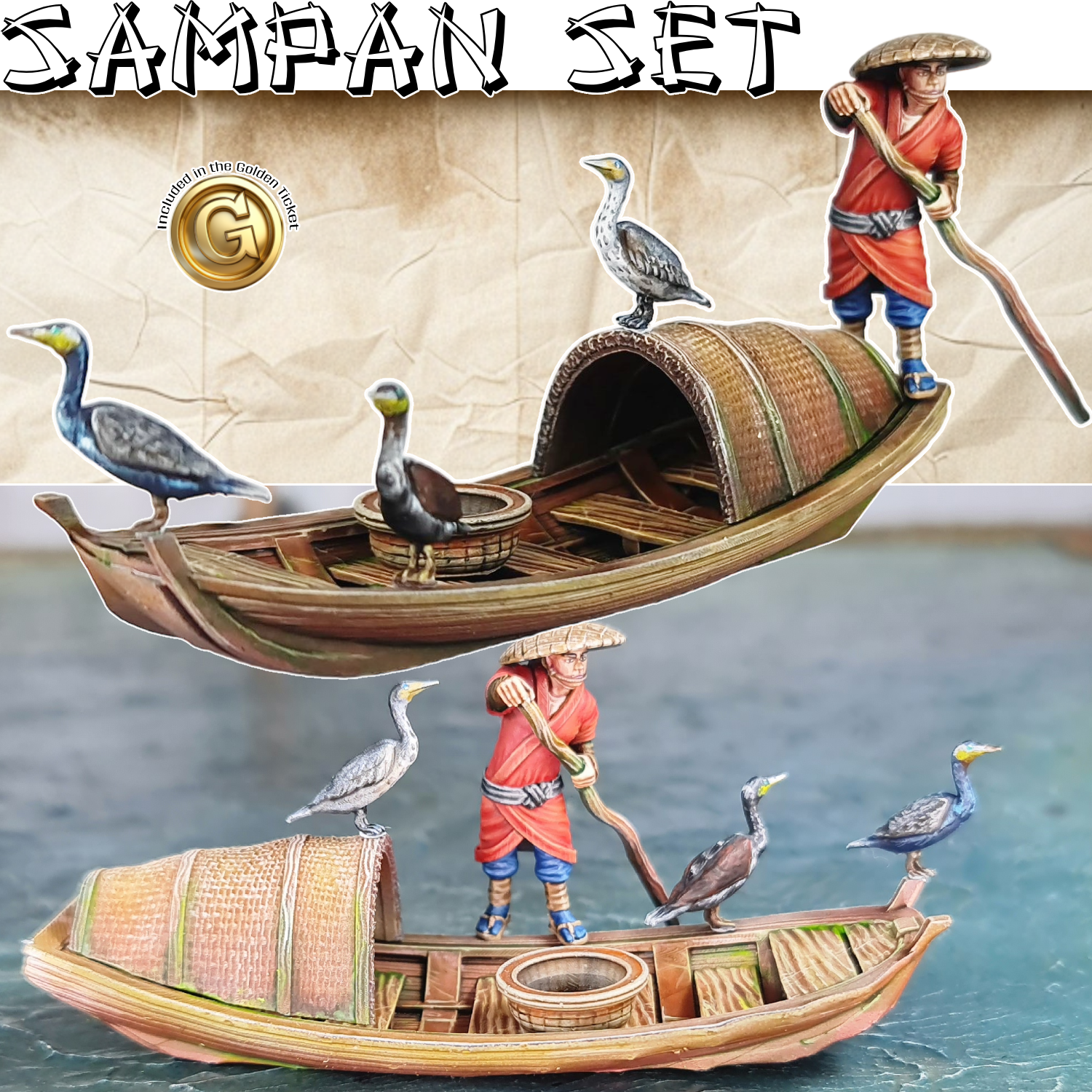
Journey along the serene rivers of ancient Asia with our masterfully crafted Sampan Set. This exquisite collection captures a moment frozen in time: a skilled fisherman, his boat laden with the tools of his trade, accompanied by his loyal cormorants. The intricate details, from the weathered planks of the sampan to the focused gaze of the fisherman, bring this ancient tradition to life, promising to be a stunning centerpiece for any diorama or gaming table.
Elevate your wargaming scenarios and role-playing adventures with unparalleled authenticity. Whether you’re navigating the waterways in a historical skirmish, setting an ambush in a fantasy realm, or creating a bustling port scene, this Sampan Set provides the perfect narrative element. Populate your world with characters and scenery that tell a story, transforming every game into a memorable, immersive experience.
This set contains the 3D printable STL files for a traditional Sampan boat, a Cormorant Fisherman miniature, and several cormorant bird miniatures. Every element has been sculpted with exceptional detail, featuring realistic wood grain textures on the boat’s hull, an authentic woven pattern on the canopy, and finely rendered details on the fisherman’s attire and the birds’ plumage. These models are scaled for 28mm and 32mm tabletop games, making them perfectly compatible with a wide range of popular wargaming and RPG systems.
The Sampan boat itself is designed for optimal printing on FDM machines, requiring no supports for a clean and straightforward print. The Fisherman and Cormorant miniatures are highly detailed and are best suited for resin 3D printers to capture every subtle feature. In gameplay, this set can serve as a dynamic terrain piece, a vehicle for player characters, an objective marker in a river-based scenario, or simply as beautiful scatter terrain to enrich your game board.
Historical Context: Cormorant Fishing
The scene depicted in this set is a tribute to the ancient and fascinating tradition of cormorant fishing, a practice with over a thousand years of history in both China and Japan. Known as ‘ukai’ in Japan and ‘lúcí bǔ yú’ in China, this unique fishing method involves a profound partnership between humans and birds. Fishermen train cormorants to dive into the water and catch fish. To prevent the birds from swallowing their larger catches, a snare is tied loosely around the base of their throat. The birds are trained to return to the boat with the fish, which the fisherman then retrieves.
This tradition dates back as far as the 6th century. In Japan, cormorant fishing on the Nagara River has been practiced for over 1300 years and was once a protected activity of the imperial court, with the official title of ‘usho’ (cormorant fishing master) being a hereditary position. In China, the practice is often associated with the picturesque rivers of Guangxi province, like the Li River near Guilin, where fishermen on bamboo rafts or small sampans work with their birds against a backdrop of dramatic karst mountains. The boat itself, the sampan, is a testament to ingenious simplicity. The name, derived from the Cantonese ‘sāam báan’ (三板), literally means ‘three planks’. These flat-bottomed wooden boats have been a ubiquitous sight on the rivers and coastlines of East and Southeast Asia for centuries, used for everything from fishing and transportation to housing. This model set captures not just a boat, but a piece of living history, a symbol of a sustainable and harmonious way of life that has endured for generations.
Related products