Viking Noblewoman Miniature – Norse Saga Collection – 3D Printable
$3.00
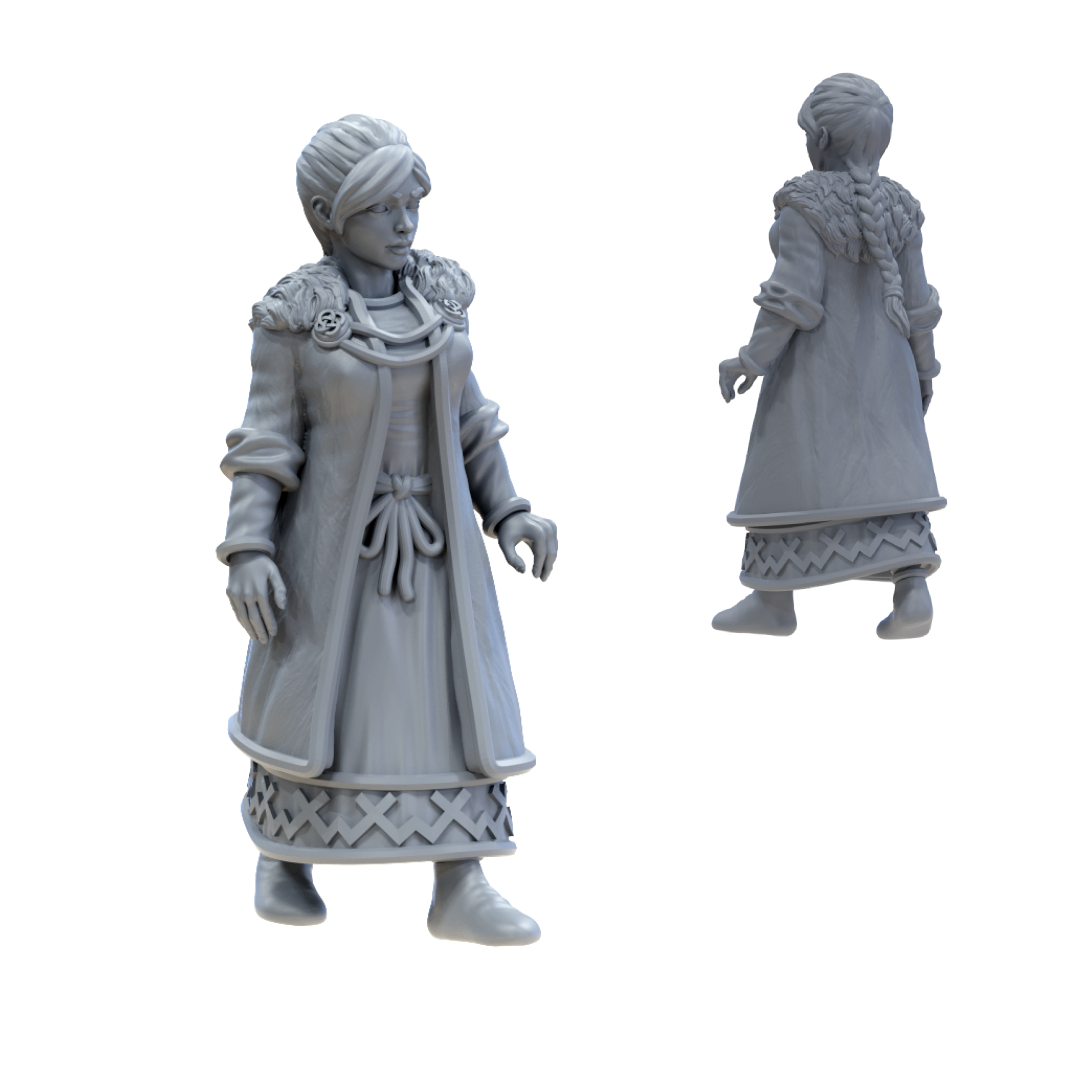
Grace your tabletop with the presence of this exquisite Viking Noblewoman. Sculpted with a commanding yet elegant posture, she is the perfect character to represent a powerful Jarl’s wife, a revered seeress, or a key figure in your historical and fantasy sagas.
Her attire, rich with authentic detail from the intricate braid to the fur-lined coat, brings a touch of Norse aristocracy to your collection. This miniature is designed to be a standout piece, embodying the strength and dignity of the women of the North.
This digital STL file offers a highly detailed Viking Noblewoman miniature, meticulously crafted for tabletop gaming enthusiasts. The model is scaled for the popular 28mm and 32mm wargaming standards, making her a perfect fit for a wide range of historical and fantasy settings, from a bustling Viking settlement in a game of SAGA to a noble NPC in a Dungeons & Dragons campaign set in a northern realm.
The sculpt features crisp, well-defined textures, including the rough warmth of her fur collar, the woven pattern on her dress hem, and the intricate strands of her magnificent braid. These details are optimized for high-resolution resin 3D printers to capture every nuance, though the model can also be successfully printed on a well-calibrated FDM printer. In gameplay, she can serve as a quest-giver, a civilian objective to be protected, or the powerful matriarch of a clan whose favor the players must win.
Historically, women in the Viking Age (roughly 793–1066 AD) held a remarkably progressive status compared to many of their contemporaries in other parts of Europe. While society was patriarchal, Norse women enjoyed a significant degree of freedom and authority. The miniature’s proud bearing and fine clothing reflect the status of a woman from a powerful family. Free women could own property, inherit land and titles, and represent themselves in legal matters. A marriage was a contract between two families, and the bride brought with her a dowry which remained her personal property.
The most powerful woman in a household was the ‘húsfreyja’ or ‘lady of the house’. She was the keeper of the keys—symbolized by keys often being worn on her belt—granting her authority over the household’s stores, finances, and domestic production. While the men were away trading, raiding, or exploring, it was the women who managed the farms, businesses, and family affairs, ensuring the community’s survival. This miniature could well represent such a key-bearer, a figure of immense practical power. Her clothing, including the long underdress (serk), overdress (aprondress or hangerok), and the warm cloak or coat, is consistent with archaeological finds and historical depictions. The jewelry, like the torc around her neck, was not just decorative but a display of wealth and social standing. While the concept of shieldmaidens (skjaldmær) is primarily found in sagas and folklore, with archaeological evidence being debated, the underlying spirit of a strong, capable woman was a core reality of Norse society. This figure honors that legacy, a testament to the resilient and influential women of the Viking Age.